The general public comes and goes. So do mall cops and security guards.
Some guards stay for years, others work short stints & some are “no show”
Shifts start at sunrise, others at midnight. Double shifts are common, especially if there are “no shows” or a spike in activity be that good (a concert) or bad (a riot).
Where are they now? What becomes of them?
Some start school, others return to school or find careers. Some just drift away to parts unknown
They come in all sizes, colors, cultures and hail from all backgrounds.
What unites them? Why do they do it?
To become filthy rich (not likely on a mall cop/security guard pay)
Become famous. Only if you do something really stupid or really heroic on a national scale and end up on the evening news.
Become a cop. A logical gateway to that noble profession.
Meet members of the opposite sex or just keep busy and stay out of trouble. Too much of the first item on this list and you are likely to get into some trouble.
Last but not least (and most likely)….it’s to pay bills.
But over time, it’s a sense of camaraderie, a sense of dedication, a sense of “all for one and one for all” (like the ancient knights of the Round Table in the days of King Arthur and Robin Hood’s band of merry men).
In the end, it’s an understanding that we have each others back in times of need. We’re generally an invisible afterthought to the busy public. That is until an alarm rings, a fight breaks out, smoke fills the air, a shot is fired or a bomb goes off. We suddenly become important and appreciated. When things settle down and get back to normal (whatever that is), we fade again into the background
Hell bent on the highway to hell back then. Are we on the same highway today?
Full disclosure, I stopped reading Medium posts and writing posts since Story TV (sort of a variation of the History Channel, my other addiction) ran an entire day of programming concerning The Rise & Fall of The Roman Empire. Now I’m catching up.
What follows is my observations based upon binge watching. You probably already known these observations but my goal is to publish them, especially in advance of the 2024 national election:
Fact then: Roman empire got over extended. Battling forces on multiple fronts. Military overextended. Budget over extended. Loss of control at the extremities. Resentments and anxieties grow on all frontiers.
Fact now: same situation
Fact then: Corruption, infighting, polarization and internal tensions. Economic inequality, over-taxation, personal egoes and animosities trump the greater good of the nation and society
Fact now: same situation
Fact then: Roman leaders supporting pagan gods scapegoated the new christians especially when plagues threatened to destroy the society. Scapegoating the poorest, the politically weakest, those who look and speak differently. In sum, the easy targets. Bottom line, divide and conquer.
Fact now: same situation
Fact then: The roman empire cajoled, bribed, cut deals with the barbarians when they realized that barbarians had the upper hand as roman coffers were depleted and their military was overextended.
Fact now: we do the same. CIA conducts covert operations, State Department pays ransoms, cuts deals, Specal Ops launch surgical operations
Fact then: Romans had to utilize “auxillaries” who were basically mercinaries, unfortunate folks from conquered areas and the poor needing money opting for military service. Romans had a voluntary military service requiring creative ways of filling the ranks , especially when their rich and comfortable residents had no need or desire to join the military.
Fact today: We encourage our lowest income and working class residents to join the miliary on the promise that “their college debts will be forgiven”. Is it no coincidence that our exploding college debt coincides with out transfer to a volunteer only based military? We use mercinaries, so did the romans.
Fact then: Every military incursion was driven by the need for the emporor to establish a strong military resume. The roman empire did not need to expand as evidenced by their misguided incursion into the British Isles. Classic example of getting overextended.
Fact now: We got Saddam pushed out of Kuwait . Mission accomplished. So why did we have to re-invaded under Bush Jr. into Iraq?
Obama got Bin Laden, so why did we stay there many years afterwared?
Fact then: Romans considered themselves superior to those outside of the empire and more civilized than the barbarians. They used this rationale to justify expanded Roman territory. Romans threw their weight around when they were the superpower of that era.
Fact now: USA followed misguided policy of nation building, especially after the fall of the Soviet Union. USA constantly refers to exceptionalism and manifest destiny but doesn’t consider how that sounds to those outside of the USA.
Fact then: Romans revelled in blood sports with gladiators entertaining them in colosseums. General population became soft and complacent
Fact now: We have our stadiums and football games that have a sacraficial gladiator feel to them. Full disclosure, my guilty pleasure is watching football (American version) and rooting for my team (New England Patriots) but a gnawing sense of unease creeps into my consciousness. Like the Romans, our society is lulled into complacency and obesity as we gorge on entertainment watching our screens, playing our computer games and eating our chips.
Fact then: Romans were dragged down by plagues during the 300 years following the birth of Christ. They turned on eachother internally while barbarians attacked on all external fronts. The empire ran out of time, money, resources and the ability to cope with the death spiral it found itself in.
Fact now: I could go on and on with comparisons but I wanted to end with a glimmer of hope. We still have time to right this sinking ship but only if we steer away from the declining Roman Empire course. Only time, fortitude and courage will determine our fate.
Boomer who’s a late bloomer to writing/blogging and loving it! Published novel MALL CHILD based on 15 years as weekend mall cop & 40 years as city planner
If you were a cop, would you rather direct traffic at a construction site or put a bullet through the skull of a mass shooter about to kill a bunch of kids? When your shift ends and you hang up your service belt, which gives you a greater sense of accomplshment, appreciation and purpose?
When you said in 3rd grade that you wanted to be a cop, did you dream of aimlessly patrolling neighborhoods not sure of what nefarious character you were looking for? When you played cops & robbers the mission was clear: catch the bad guys. Why is that mission now so murky?
When I chatted with a buddy whose a retired cop, he commiserated that cops spend way too much time doing paperwork. Same observations are made by retired teachers who complain that record keeping has taken priority over teaching, which was their reason they entered the profession in the first place. Teachers frequently complain about teaching to the test rather than to the student. Social workers also complain about the revolving door syndrome processing reports concerning the same clients who are in their words “frequent fliers”. The clients participate in a variety of programs but never address root causes of their distressed state in life.
Back to my cop buddy and his angst about report writing, I suggested that filling out paperwork at scenes such as vandalism with minor property damage, might be handled by what I called Community Agents. I used the term “agent” because in these circumstances it’s more just an insurance claim matter. A uniformed Community Agent could be equipped with a panic button and a 2-way radio in case of emergency or an unforseen turn of events. A cop who’s already on patrol could be notified that the Community Agent was on-scene investigating some act of vandalism or even a minor fender bender just in case a benign situation escalated. The Community Agent could also be an extra set of eyes & ears in the community reporting suspicious activity or alarming trends.
My cop buddy liked the idea of being freed up from the drudgery of report writing. However, he was skeptical of the notion of giving up extra pay that comes with directing traffic at construction sites if cops were replaced with less costly flagmen. I also sensed some reticence about having non-cops whether they are Community Agents, social workers, outreach workers or citizen advisory/liasion members doing ride-alongs. Likewise, my retired teacher buddies were supportive of sending disruptive students to a specialist who could deal with root causes of disruptive behavior. However, as with the cops, I sensed some concerns and possibly some trust issues about having this extra helper in their classroom. For cops and teachers (and everybody for that matter), there is a fear of loosing control and being evaluated and possibly misunderstood. My answer to this understandable concern is to put in place oversight whereby the “helpers” really get to “help” and those who are being helped (the cops, teachers or whomever) are not being unjustly judged or spied upon. A side benefit to this re-structuring would be the weeding out of bad cops, bad teachers, bad employees of whatever the profession. Furthermore, this might lead to more cost effective delivery of services. Tax payers would benefit.
I appreciate these concerns and reluctance to change institutional cultures. However, we can not keep doing things the same way over and over and expect different results. More cops, more teachers, more social workers or more of whatever profession being discussed without fundamental changes will never dig us out of this hole.
Taking the afore mentioned baby steps might move us closer to revamping the definition of what it means to be a cop, teacher, social worker or whatever profession needs revamping. Maybe if we inch toward transitioning employees in the helping/social services fields to become mentors rather than straightjacketing them with outdated roles and titles, we might, in the long run, make these fields more rewarding. Coincidentally these are the fields experiencing severe recruitment and retention issues. There is concern that these fields are not attracting the best, the brightest and most importantly the most appropriate and most motivated. Cops will always be needed to break up bar fights, teachers will always need to teach reading-writing-arithmatic and social workers will always need to administer programs. That said, we should stop forcing these professionals to be “all things to all people”.
Some examples:
Cops: Contract with a “geek squad” to ferret out computer crimes, fraud, white collar crimes, hate speech, and other indicators that are precursers to a tragedy on the doorstep of the community. I support protections of civil liberties so we certainly still need to obtain warrants and show probabale cause if the case advances in the criminal justice system. However, every police chief will note that a very small percent of the community is the source of crime and disorder in any community. So why can’t we free up cops to become mentors to this limited group? It would be more cost effective to transition to what I call micro-policing. We used to call this Community Policing but I suggest taking it the next step to micro-policing. Furthermore, all too often Community Policing was relegated to a special unit having limited impact among the entire police department and sometimes (not always) just amounting to “window dressing” as a demonstration of community involvement. This same “window dressing” has unfortunately applied to compartmentalization with creation of Youth/School Resource Officers. We still need to have a limited (but sufficient) amount of resources devoted to addressing the “outsider” who’s passing thru town and causing trouble. More intensive video surveillance of the public streets would document whatever crime or accidents occur. Let the camera augment the conviction rates while the cops time is freed up mentoring and networking with those most in need of re-directing.
Teachers: Every teacher hopefully loves the subject they teach. Math for the mathmatician, history for the history buff, etc. If their time could be freed up so they can work more intensively with each student sharing their zest for the subject, wouldn’t that be a more productive teaching style. That would replace the “classroom management” that sucks up so much of a teachers time and energy. The phrase “when the student’s ready to learn, the teacher can teach” sums up this notion which only happens when the teacher is freed up for an intensive mentorship role.
Social workers and heath care professionals: Unless their time/energy is freed up enabling them to get to the root problems affecting their clients and patients, they will continue to busy themselves (and burn out) treating symptoms rather than addressing causes.
So back to my initial graphic question directed to cops: “Do you want to direct traffic of capture monsters?”
This question could be broadened to whatever profession that’s under the microscope. Depending upon the answer that’s given, it raises the further question “Is this really the right profession for you and what’s your true motivation?”
Boomer who’s a late bloomer to writing/blogging and loving it! Published novel MALL CHILD based on 15 years as weekend mall cop & 40 years as city planner
It may count but how and where do we find you and how do we get you to vote
I was inspired to write this blog because of that infamous conversation Trump had with the Georgia Secretary of State asking him to FIND votes. Actually “inspired” is probably the wrong word. “Repulsed” is a better fit. However, it got me to thinking…..Can I find 5 persons who I can convince to vote in support of my candidte in the 2024 election?
My answer: Other than finding 5 members of the BASE (and I’m not sure of who and where these folks are so I can approach them), I seriously doubt there are 5 persons who I can convince, convert, or motivate in time for November 2024.
This is why:
Extreemly polarized persons. Minds are made up.
Extreemly indecisive persons. They are forever fence sitters. (Tip: don’t stand behind them in line at the grocery store when the clerk ask “paper or plastic”, you will be there all day)
Extreemly disgusted, disgrunteled, disconnected and distrustfull persons. They are the folks that say things like ….”their all crooked”, “life’s a bitch and then you die”, “it’ll never change”, “the deck is stacked against us”.
Extreemly disinterested persons. They’re folks that say thinks like…”I don’t follow politics” or “that doesn’t concern me”. Getting these folks to vote would be like getting someone who hates broccli to try it. For the record, I’m ok with broccli.
And that brings me back to THE BASE. These are the persons who already support your candidate. We can count on the strong supporters to be voters. It’s those who are lackadasical that we need to make sure they get to the polls. For me, this is what the term “growing the base” means. Time, energy and resources spent on any of the other folks listed in this article might be wasted. The ROI (Return On Investement) concerning them is probably negligible. If we do not sufficiently identify and motivate this “silent majority” among THE BASE and turn them out in such significant numbers so that the opposition is trounced, the election and possibly our democracy is lost.
One last note, so I do not leave with the impression that I have given up on conversing and convincing others. I recently did some soul searching thinking about when was the last time I had a conversation or read or heard something in which I changed my mind or garnered a new perspective. For me it was reading the memoir of Sarah McBride (Titled: Tomorrow Will be Different: Love, Loss & the Fight For Trans Equality). I wanted to give her a shout-out because it provided me with an in-depth understanding and appreciation for issues affiliated with LGBTQ and Trans Persons.
I added this comment since it’s my observation that unless the person you are recruiting to vote in support of your candidate experiences some sort of epithamy, they are not budging from their opposition or their inertia. Since I’m a history buff always watching for the arc of history, I offer the following waatershed moments in USA history when THE BASE sufficiently expanded to enable a redirection of the course of history.
These moments/movements were:
Abolition and the end of slavery (though in many ways the civil war continues)
Suffraget movement…giving women the right to vote.
WW2….collective understanding that we had to crush Hitler and the Japanese emperor
The New Deal and the start of something called Social Security (granted it took The Great Depression for people to warm up to this idea)
The civil rights movement. End of Jim Crow, segregation, etc.
End of the Vietnam war. Recognition that it was time to leave
So what’s the WATERSHED moment we are living in right now? Are we in a watershed moment? I fear we are NOT at that inflection point. There I go again being a glass-half-empty guy. The existential threat posed by global warming is not yet garnering the urgency and collective action required for real change. Hell, the pandemic didn’t create societal solidarity since we continued to quibble about masking, opening/closing schools & businesses and debating the origins of the damed thing.
Oh well, I still support thinking globally and acting locally so I guess I will get busy searching for those 5 votes.
Boomer who’s a late bloomer to writing/blogging and loving it! Published novel MALL CHILD based on 15 years as weekend mall cop & 40 years as city planner
I walked into the hospital room a couple of steps behind my dad who swung back the curtain that’s supposed to provide a modicum of privacy. There lay a yellow man shaking and moaning. Tubes jammed up his nose and smaller intravenous lines running along what used to be strong arms. Eyes mostly closed but unfocused when his eyelids fluttered. To this day, I wondered what he saw? Visions. Blackness. Memories.
Dad whispered, “he’s got the DTs. It won’t be long now”. Looking back, I’m not sure why he whispered. Why do any of us whisper when on death’s doorstep? Maybe it’s out of respect. Maybe we think they will hear us. Maybe there’s a glimmer of hope among those folks who are “glass half full types”. I’m not one of them. I’m a boxer that takes that initial punch, then fights like hell but accepts the consequences of the round when the bell rings.
Even at age 13, I knew DT’s meant Delirium Tremens signaling end stage alcoholism. Being Irish-American, it’s that ghost that lurks in the liquor cabinets calling your name at the happy times, the sad times and the lonely times. Even now in my retirement years, that specter haunts me as I polish off a bottle during evenings of reading and writing. Gotta keep that ghost in the closet.

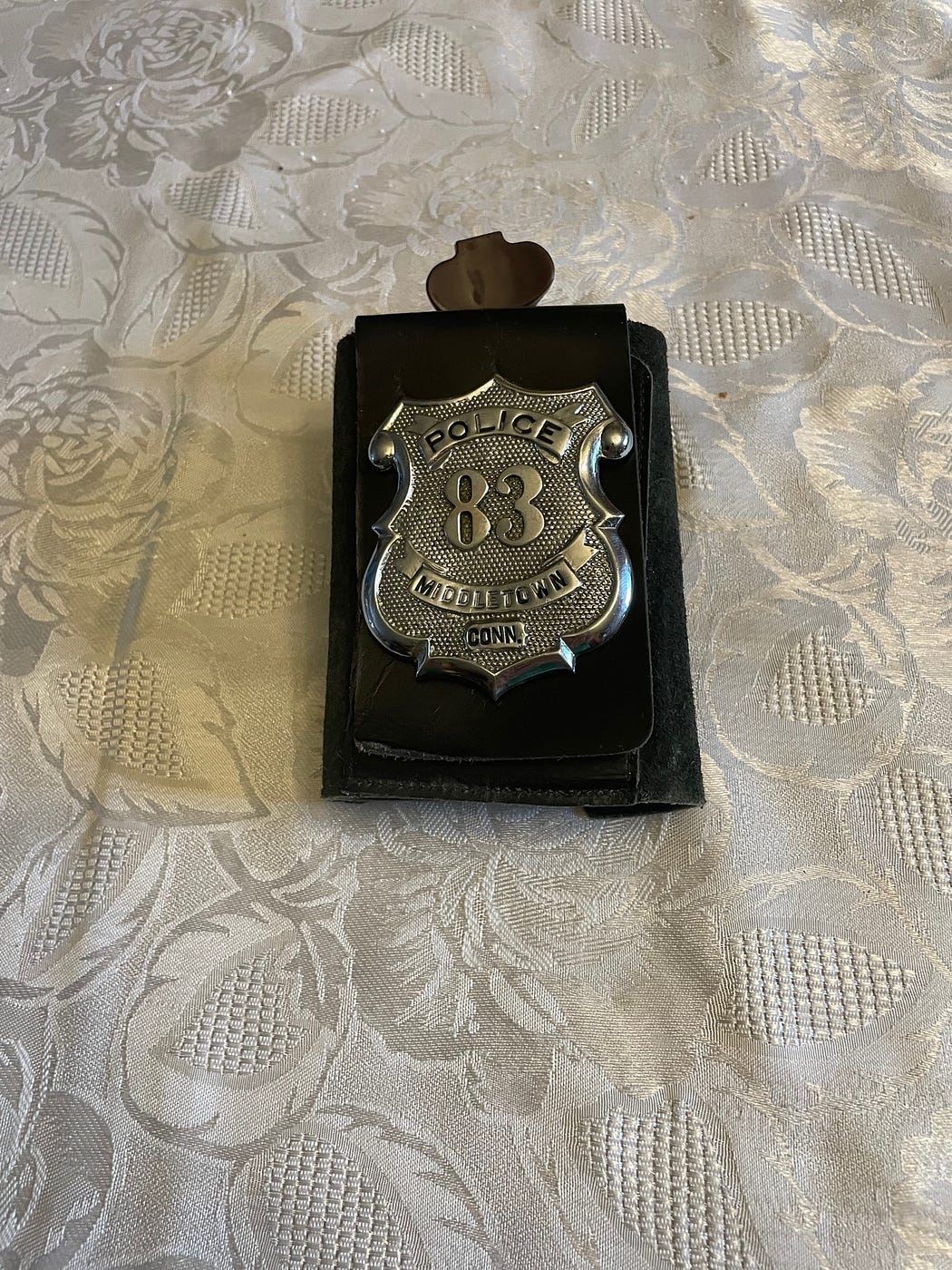
Back at the hospital, uncle Charlie was a shadow of his former six foot 300 pound self. In healthier days, he sported a Santa Claus physique. His personality, as best I could tell, was not that of jolly old St. Nick. I’m not implying he was nasty, cranky or cantankerous. As a matter of fact, I heard he was not a mean drunk. Thank goodness since he was never without a revolver and a blackjack. I also never heard stories about beating his wife (my beloved Aunt Margaret) who was his drinking partner and a nice person.
I had very few interactions with uncle Charlie. I wish I asked him what it was like to be a cop in the 1960’s in the midst of race riots. As a history buff who’s a junkie for all topics about societal issues, I hunger for such conversations. Since I’m now a retired mall cop, we could have spent hours trading stories, escapades and commiserating about society’s challenges. But that was not to be. Alcoholism took him too soon, I was sheltered from that scourge and I was born too late. Years later my aunt Agnes told me about the time a car ripped the stripe off the side of his pants while he was directing traffic. And then there was the time he reportedly fake arrested her as a shoplifter on Main Street much to her embarrassment. It was all for a good cause. He had to have an excuse to put her in the patrol car to give her a ride home since she was loaded down with groceries. Reportedly there was an incident when he and another cop were checking out a building responding to a burglary call. For some reason, he and his partner were in separate sections of the building and the partner’s gun accidentally discharged. This was back in the day when cops actually walked beats and before SWAT teams. This was in a time when you didn’t have to account for your ammo or fill out paperwork concerning such incidents. First hand accounts from Charlie would have been nice but at least my aunt passed down what now is family folklore. My gnawing regret is that I only knew him in two dimensions as a cop and an alcoholic. And he was good at being both. My first cousin, who was 12 years older than me, mentioned he appreciated that Charlie was like a father to him because his own dad was what I guess you would call a “working alcoholic”. Again, troubles swirled around but I was young and buffered from these storms. This enabling me to be the first on this side of the family to go on to college and even on to graduate school.
I don’t recall discussions about Charlie at the dinner table even though his downward spiral had to have weighed heavy on all family members. We lived in the same town, he was a local cop and WW2 vet. I wish I had been privy to his current struggles, hopes and dreams. He served in the army in the campaign to rid Italy of Mussolini. I heard that he was blown out of a foxhole and for a time his young bride thought he might have died. Fortunately he was patched up with no long term physical ailments. Though now that I’m retired from a career related to mental health and addictions, I wonder what psychological scars remained and what role they might have played with the alcoholism. With no conversations and the misalignment of time with me being a kid and him being an adult, I will never know.

Being kept in the dark and sheltered from family troubles and financial troubles was a characteristic of growing up in the 1960’s and 1970’s, It’s also a characteristic of Irish-Catholic and Irish American households. The best demonstration of compartmentalism and sweeping your troubles under the carpet is how the Irish make references to the “Troubles” when describing what’s really civil wars and rebellions.
Looking back to that hospital visit, I wondered about its circumstances and purpose.
Did my dad want to make sure I got a first hand glimpse of alcoholism’s descent into hell. Did he want this to be a scared-straight type experience?
Was my dad notified that this would be a last-chance visit to see his older brother? My mom worked the day shift and dad worked the midnight shift, so maybe I was tagging along just so I would not be left alone.
Answers to these questions I will never know. Leading up to this hospital visit, during it and after it, I don’t recall any debriefing or in depth conversation. This pattern of doing but never discussing is a recurring theme for most events of my life.
Even when it was time to attend uncle Charlie’s wake and funeral, which presumably happened soon after that hospital visit, I’m hazy about what transpired. I’m even a bit embarrassed about being unclear as to whether I attended. I’m assuming I did since it happened way before I went off to college. It was at his wake that I recall my uncle Louie (my fathers and my uncle Charlie’s oldest brother) making the following remarks under his breath after mourners offered the traditional consolation “sorry for your troubles” (there’s that word “troubles” again):
After one mourner passed beyond ear shot, Uncle Louie remarked:
“I’d like to punch that sneaky bastard in the mouth. Screwed me in a deal”.
After another mourner passed, he informed me “that’s the king”, to which I asked “the king of what? He said “the chairman of the local political party and he’s a high ranking state official”. Maybe that’s when I decided to major in political science in college.
I’m wondering if I suffer from a special kind of amnesia in which I remember snippets of what should have been a panoramic recollection of memorable and emotional events. I’ve attended my share of weddings, funerals, and graduations. But the memories are choppy. It’s like knowing you attended a movie but you only recall certain lines and scenes. It concerns me that I only recall the anecdotal, quirky and weird stuff. Even worse, I have difficulty remembering if I even attended these supposedly momentous events. Was I AWOL? If so, what else was I doing? Was I in attendance but somehow disconnected like a sleepwalker or zombie?
I’ve wrestled with this sense of selective amnesia and missing conversations. I’ve come to the following solution. I’ve made a concerted effort to have in-depth and candid discussions with my kids on matters such as family, finances, troubles and the watershed moments of life. I’m hell bent on making sure they remain aware of the big picture and as the saying goes “not miss the forest for the trees”.
Since I retired this month, I have spent at least an hour or two every day reviewing financial papers and other seemingly important household files and documents while I scan, save and shred them. Its a laborious but necessary task getting my affairs in order. For the record, as far as I know, I’m in good health. I’m doing this for my own sanity and my goal is to have everything in order so my kids are not burdened by this mess in the event of my death.
While perusing the “paper trail of my life”, the following reflections, observations, emotions and recommendations have bubbled to the surface:
An inordinate amount of life and energy has been spent treading water just staying above the financial water line working 2 and 3 jobs at the same time. Keeping up with daily expenses is akin to the expression “missing the forrest for the trees”.
The daily grind of lifes routine prevents comtemplation, reflection or an understanding of the bigger picture concerning finances, careers, plans, goals, hopes and dreams. In sum, it’s a deadening, numbing, soul crushing treadmill of missed opportunities. Now that I’m retired and sorting this material, I better understand priorities and how things work. My thoughts drift into that realm of “wooda-coulda-shoudda”. Unfortuatey, as a boomer it’s very late in the game. I guess it’s better late than never. If only I had a better sense of the big picture much earlier in life, I might have had a more productive, lucrative and relaxed life.
Seeing the mountain of paper, documents, financial statements and files while viewing the miniscule amounts of savings and investments seems absurd. The phrase “much ado about nothing” comes to mind. I yearn for a simple, uncluttered life following the mantra of KISS (Keep It Simple Stupid). A wave of emotional and physical exhaustion washed over me while reviewing files concerning what at the time were urgent and complicated matters such as home buying, car buying, college debt financing, medical expenses, insurance expenses and finances in general. For a simple, working class guy like me, I wish there was some sort of postcard size format that addressed the absolute basics: food, clothing, shelter and medical expenses to patch me up if I get sick. Noting elaborate concerning these basic human needs. Is this simple life too much to ask for? I haven’t worked in the coal mines and textile plants like my ancestors. However, while digitizing this material, I now share a kindred spirit with them plodding from sun up to sun down putting one foot ahead of the other. I have found no records of love letters, exotic trips, life changing events or new paridims of thinking. There are only tax filings, W2’s, mortgages, and the never ending treadmill of invoices. There must be more to life than this.
My advice to the younger generation includes the following: invest early, often and wisely. Live below your means. Avoid interest charges and credit debt to the greatest extent possible. Get an annual fiscal check up just like you get a physical check up and routine teeth cleaning. The earlier you can get a handle on “how things really work and what’s really important” the better off you will be in the long run. Don’t be a late-blooming boomer. Be the captain of your ship. Don’t drift with the tide. My advice to youngsters (and anyone for that matter) is to aim your ship to high ground. From there you will operate from positions of strength, maintaining low or no debts, high levels of equity and be vigilant to pursue opportunities as they arise.
Beyond running the good race and running on empty most of my life, I wondered what else has occupied my time and energy all these years. The answer: minuscia. Obligations and committments (work, family, scheduling necessities) that for the most part have been externally imposed upon me. Urgent pressing matters swirlling in my head all these years revolve aroud questions such as “what do I do next and when do I do it”. Putting my house in order has made me realize that I have been living in the world of “what’s next”
So that’s my 2 cents (or factoring in for hig inflation, make that 10 cents). I would be delighted to know what reflections others have as they “Get Their Houses In Order”
While contemplating international relations and domestic relations and ancestrial relations, I observed a pattern of history repeating itself highlighted as follows:
Internationally
Roman empire overextends and declines from within. So it is with most every other empire since then. USA might be on same track
England, Soviet Union, USA all occupy Afganistan, all fail
French and then USA defeated in Vietnam
Nation building (re-building) with the possible exception of the Marshall Plan in western Europe (and that was fuelled by fear of expanding communism post WW2) has been unsuccessful
Flashpoints justifying the start of war turn out to be murky at best and fake at worst. Example: “Remember the Maine” battle cry when USA ship mysteriously blew up in Havanna harbor in Cuba triggered the Spanish-American war. The Gulf of Tonkin incident that reportedly involved North Vietnamese attack on USA ship turned out to be false.
The definition of insanity is doing the same thing over and over and expecting a different result. International relations shows characteristics of insanity
Domestically
Economic crashes (from small to large) all involve a bubble that bursts. What causes a bubble? Greed and an assumption that this time it will be different and the party can continue, that is until it’s time for a hangover.
Progressive periods are followed by regressive periods. Look no further than presidency of Abe Lincoln (abolishing slavery) followed by Andrew Johnson and the period of Reconstruction (which should be more aptly described as Destruction for recently freed slaves) and the advent of Jim Crow laws, segregation and the rise of the KKK. In sum, bad follows good.
Progress made in the 1950’s and 1960’s in terms of civil rights and desegregation but now there seems to be a rise in hate crimes, hate groups, and moves to restrict voting just to name a few.
Every period of chaos and disorder such as the Vietnam war protests and the race riots of the 1960’s, assasinations are followed by calls for “Law & Order” and a tilting back to strong man rule focusing on clamping down.
Every mass shooting is followed by calls for “thoughts & prayers” and a wringing of hands contemplating proposals to bring an end to that madness for which nobody can agree upon a common solution. History repeating itself in an insanity loop.
So what might we learn from the maddening cycle of repetition in both international and domestic relations. Since I’m a history buff who could watch the History Channel all day if I had the time, I suggest we take history more seriously. I know the STEM subjects in school are important (and more profitable) but unless we get a handle on history we are doomed to repeat the mistakes of the past.
Wouldn’t it be refreshing if we started thinking outside of the box after every period of progressiveness and after every period of regressiveness and reactiveness. Only then will we avoid the trap of history repeating itself and the failure loop.
Ancestral history repeating itself
This segment of my blog takes a different turn. One of my cousins has been doing research on our ancestors going back to the days when Olliver Cromwell conquered Ireland subjecting it to British rule. Since I just retired, I contemplated how the occupations of my ancesters and their circumstances also seem to follow a historical cyclical pattern. I highlight the following to demonstrate this observation:
Ancestors in midland England (Irish but working near town of Darwin and the village of Aspull because that’s where the jobs were found) worked in coal mines and textile factories.
Fast forward to my USA ancestors working in the Portland CT brownstone quarries, mining brownstone
Further fast forward to me working 2 summers to pay for college working in the same brownstone quarry putting up fencing and working in a feldspar rock quarry in Middletown CT and then working during the year between college and grad school in a factory making cable cutters.
Most of my ancestors were cops going back several generations up to and including my father (campus cop) and several uncles.
Fast forward to me working for 15 years on weekends as a mall cop near my house. My dad in his 60’s decided after 30+ years working the midnight shift that it was time to retire. The incident that convinced him was the night he confronted a burglar in the campus bookstore. He and the burglar dashed outside only to confront eachother in the alleyway. Dad was unarmed and thankfully the burglar ran away. Likewise, while I was about age 64, I responded to a call that a shoplifter was being pursued by the victim. When they exited the mall and the shoplifter pulled his car from the parking stall, the victim jumped on the hood of his car. The vehicle with this guy hanging on the hood headed straight for me since I was positioned in the patrol vehicle. A head on collision was narrowly averted and the guy on the hood finally fell off without any major injuries. That’s when I decided (like my dad did) that it was time for retirement.
The last full time job I had before I retired was as an employment counselor at a nonprofit agency getting persons back in the workplace. The last job my mother had before she died was as an employment counselor for the Labor Dept. of the state of CT. Go figure.
My mother used to write articles for Readers Digest at night after dinner and now I’m an author who published a novel (Mall Child) and I’m working on a memoir and a nonfiction book following my passion for writing.
One of my son’s is a physicist (material sciences specialty) and his late uncle on his mothers side of the family was a nuclear physicist. Another ancestor on my wifes side of the family had an opportunity to attend Stanford University but had to decline due to family committments to support family back in the days of the Great Depression.
My daughter works in the film and video industry and my wife spend the best years of her working career in similar jobs at a cable tv production company and a couple of video production outfits.
Now that I have some more time on my hands, it has enabled me the opportunity to connect-the-dots, beome observant of patterns and trends, think-outside-the-box, and re-evaluate beliefs and values. I look forward to your observations and reflections.
Some years ago my sons suggested that government and society should be driven by science, technology and fact-based decision making. They are physics and computer science majors coming from the world of STEM (science, tech, engineneerig, math). As a political science major and history buff, I chaffed at this sterile notion of deciding everything free of the mushiness of emotion.
Over the years with increasing levels of polarization, fake news and the sheer idiocy and vulgarity demonstrated by our “leaders”, I have joined the thought camp of my sons.
A recent conversation in the gym locker room solidified my decision. It was not really a conversation. As I was changing and the tv was documenting the events of Trump turning himself in to be arrested (sort of a reverse slow speed chase reminiscent of the O.J. Simpson white bronco episode), I sensed that a young guy near me was itching to engage in disourse about the decline of America and what he though was the persecution of Trump. He appeared to be an angry young guy, clean cut, buffed and disolusioned with America with an axe to grind about liberals, progressives, the media and “the powers that be”.
Based on past experiences, I focused on changing my clothes since I knew that there was no hope of changing his ideas or his perspectives, at least not directly.
That’s when I floated the aforementioned notion of creating an entirely new approach to society in general and politics/government in particular. I suggested to this angry/disgruntled guy, the idea that maybe we should make decisions and set policies based entirely upon facts. Maybe government and policy making could be limited to a world where there is a clear distnction between right and wrong. I didn’t delve into an example such as “the global warming/climate change” topic since I did not want to get bogged down in that turf war. However, that would be a prime example of how fact driven, evidence based could drive decision making.
I further suggested that government and politics stay out of all the gray areas and emotional mine fields. I suggested that there seem to be plenty of laws on the books to address most infractions concerning….the basic human rights, the bill of rights….civil rights…. etc. He seemed to connect with my transitioning the conversation to a more libertarian, live and let live zone of thinking.
That’s when I realized that moving conversations to a “higher ground” and finding a “common ground” without touching the 3rd rail of political lables was the best strategy for exiting that jungle of animosity that envelops most conversations today whenever those conversations expand beyond traffic and weather conditions.
When I noticed that my young, angry, buffed friend was not fully grasping my tilt in the conversation and he still seemed hung up on retribution, recrimination and polarization, I offered the following analogy.
I asked him if he followed the Star Trek series. He said yes, “it was cool”.
I asked him if he liked the Spock character and he said “yes”.
I reminded him of how cool and emotionless Spock was in the face of impending disasters and how his ability to tackle everything in an analytical, methodical manor got them out of jams.
This he liked.
I also appealed to his good old fashioned support of capitalism and the private sector. I noted how businesses are driven by profit and loss not emotions and fanciful notions.
This he also liked.
I thought about mentioning to my young friend the Invisible Hand of economic theory and how this is the force behind all that happens. I thought about explaining this notion of “the force” as the ingredient that makes everything else (government, politics, current events and the latest gossip and drama) inconsequential. I thought about connecting the Invisible Hand theory of capitalism to Star Wars since I had good luck connecting to Star Trek. Then I thought better of it, fearing that I might be overloading this young padwan.
So I left him with the concept that maybe government could be limited to functioning in a strictly evidence-based, big-picture, long term planning mode and leave the passion driven endeavors up to the individuals (as long as those passions did not violate the aforementioned rights/liberties of others).
The conversational mission was accomplished (maybe) since a polarizing conversation was avoided. An outside-the-box concept was floated and no political names or lables soiled the interaction.
This conversation reminded me of other interactions I had where a balance of tough-love, consequences-compassion gets infused with the discourse thereby avoiding the train wreck that invariably results from the “my way or the highway” conversation.
Another advantage to this “higher ground”, blue-sky approach to potentially hostile conversations is the fact that if the conversant keeps referting to their hot topic concern of the day, then it’s a signal for me to give up on any big-thinking. At that point, I know I’m conversing with a fixated person whose opinions are set in stone. An example of this might be the person who can not get over the fact that Collin Kapernack took a knee during the national anthem despite the fact that I explained that it was a symbolic gesture of protest over something he felt strongly about (i.e., police brutality). Fixated thinking will not allow insights concerning the arc of history and visionary thinking. If we consider every surge of innovation and advancement in world history, it’s been when the exploratory thinking (i.e, the Renaissance, Reformation, Age of Reason) replaced the mundane thinking (Dark Ages of years past and the book banning of today).
Maybe I will deploy this diversionary, higher ground tactic as I move forward with other conversations, especially as the 2024 election approaches. I’m looking forward to your thoughts/suggestions (and check out this outside-the-box approach that’s baked into my novel Mall Child and my blogs).
Reflections by a former mall cop and current author….
I live 1 block from the mall. Sirens wale and cop cars zoom to the mall, especially on Friday and Saturday nights responding to fights and roving crowds of loud, beligerent youths. I certainly don’t miss those mall cop days. Since I’m also a retired city planner and economic developer who is currently working in the mental health field, I suggest the following big-picture, long term strategy for systemic change and an entirely different dynamic:
Maybe it’s time for my mall (and malls in general) to transition away from the term “mall” and move to the term/concept “campus”:
Education scene vector illustration. Cartoon young happy student characters sitting on summer park green grass together, girl boy teens studying near university or college building facade background
Why:
Mixed use sites including residential, commercial/retail, entertainment and education create a natural synergy. Residents in proximity to retailers are likely to be shoppers. Workers on-site will frequent restaruants for lunch and dinner. Entertainment venues will generate repeat visitors. Educational and enriching events might offer inspiration to youths as a replacement for rumbling. Such events could include (but not be limited to), book launches (selfishly suggesting my Mall Child novel), poetry slams, debates, cooking demonstrations, and all sorts of DIY events. Imaging that, a trip to the mall where you learned something, got inspired and did not get into a fight. Last, but not least, let’s consider establishing “Maker Spaces” at malls where entrepreneurs can experiment with “making/inventing” stuff. Let’s re-create the Yankee Ingenuity that New England is famous for.
Transit oriented development emphasizing mass transit and pedestrian orientations encourage a “village atmosphere” which includes mixes of generations, cultures, services and goods. Maybe we could get back to the New England tradition of the “town square”. Maybe even go further back to the European and Middle Eastern notion of “market place” or “bazaar” rather than the bizarreness of a sterile, hostile cavern of shallowness in the midst of isolating suburban sprawl.
Once malls transition to mixed use spaces occupied by persons who have a legitimate reason for being there (rather than hanging out and causing trouble), they become livable spaces enticing visitors. If the ratio of purposeful patrons far exceeds the proportion of mischeiveous patrons, the overall atmosphere and appeal of the site imporves.
The word “mall” has developed such a negative connotation that maybe “campus” is preferable. It harks back to college memories of a self-contained, identifiable area that includes sports/athletics, education, entertainment, residential areas and of course “retail” albiet on a smaller footprint since, after all, the site is still a “mall”.
Last but not least, college campuses engender a sense of pride and belonging (i.e., school spirit, mascots, alumni, etc.) so maybe if “malls” could transition to “community campuses” we might vere off the “mall decline path” that paralles the “downtown decline path” which ironically declined thanks the the malls.
As for some more specific proposals and logistical procedures, I highlight the following:
Maintain a police sub-station since the cops need an on-site place for paperwork, processing, meeting and temporarily holding persons subsequent to incidents/investigations.
Adjacent to the police sub-station, add what I call a “Recovery Room” staffed by counselors/therapists who can immediately provide counselling and redirecting to the disruptors (the belicose, disorderly, fighthing individuals). This room should be equiped with a large screen video feed which documents the incident (the fight, the disruptions, the rage, the arguments) so persns of all ages and juvenilles (with their parents/guardians present) could review what actually happened and how this behavior could be avoided going forward. To accomplish this level of video documention of incidents, I recommend a level of camera surveillance that mirrors that of the casinos. This level of camera documentation would leave no question as to “who did what to whom and what precipitated the incident”. The mall can still require the parties involved in disruptive behaviors be banned from the mall. The camera system would augment this policy. Likewise, charges can still be levied depending upon the severity of the infraction, the desire of aggrieved parties to press charges or the mall management should they also opt to press charges. Lastly, the option to apply criminal charges could be applied if the combatants (guardians/parents in the case of juvenilles) opted out of receiving the counselling and theraputic intervention offered in the wake of incidents. For a relatively minor infraction this “on-the-spot” theraputic intervention could be a “one-and-done” event. For more severe infractions (and following the recommendation of the police), a series of such theraputic interventions could be required. If the adult combatants or the parents/guardians of the juveniles reject the offer for theraputic interventions, they could always be required to go the traditional court/criminal justice route. In sum, this proposal offers a restorative justice scenario that might actually get to the root of anti- social issues rather that the traditional method of clogging up the courts. Getting to root causes is important is light of increasing gun violence and the cycle of retribution. The video documentation format would counter the claim by combatants that “it wasn’t me” or “he started it”. Making the combatant wait till the parent/guardian arrives and requiring everyone to view these videos while receiving counselling and guidance might be more effective than just requiring a Promise To Appear (PTA) at some future court date. The goal here is to get to the source of the destructive, anti-social behavior and immediately apply a sense of restorative justice and closure. This proposal is not just for unruly youths. In my years of working as a mall cop, I lost track of the number of shoplifting incidents and patron-merchant disputes that escalated to verbal threats and in some cases physical outbursts. What I have observed over 15 years is an escalation of rage (in the parking lot, in the store) with more and more persons living in an emotional hair-trigger mode. My proposal for the “Recovery Room” is to deploy the use of camera technology and professional mediators to “decellerate toddler outbursts” and address root causes to achieve lasting change. Many a time, I recall commenting to a youngster that if they continue on their angry path, they will not be successful or happy in life. Maybe my proposal could formalize this chat and actually bring the message home to them.
If this process consistently reinforces the notion that continued bad-behavior will result in criminal charges and banning from the site, those persons who are hell bent on raising hell at the mall will avoid future visits to the mall.
Design this “Recovery Room” to be a professional, inviting space with the technical video capabilities that will enable participants to review the circumstances that let them to this room This should be designed and staffed so participants (both juvenilles and parents/guardians) receive the counselling and guidance they need to understand why they act the way they do and what are some coping strategies to avert this negative behavior in the future. If done properly, this room, procedure and the strategy of tough-love should accomplish more lasting results that the traditional “catch em, charge em, release em”. The “Recovery Room” should not feel like a cinderblock cell from the Soviet Union era.
Maybe adjacent to the Recovery Room there could be the “Rage Room”. This could be a place where pent up anxieties could be released on items such as heavy boxing bags and other apparatus enabling persons to “blow off steam”. As someone who punches a heavy boxing bag to reduce stress, I vouch for the effectiveness of this. Rage Rooms are even gaining some traction as a commercial venture just as “Escape Rooms” have cropped up on the commercial market. Maybe there’s even some money to be made here among all sorts of patrons since after all the “mall” is still a retail space marketing.
So that’s my long-winded observation and proposal. I’d love your feedback and brainstorming on this topic. Some of these “outside-the-box” ideas have also been baked into my novel Mall Child so check it out on Amazon if you are interested.
With football season wrapping up, basketball season underway, and mascots dancing/prancing on sidelines and college tuitions keep going up. It got me to proposing that we ditch mascot hoopla and ditch tuition increases.
I got nothing specific against mascots, it’s more about what they represent:
Blind, hysterical affection for the school for no particular reason. Cut the tuition rate in half and I will become a mascot as the schools biggest fan hooting/hollering and doing cartwheels on the sideline.
Overpriced stadiums, bloated sports programs. Beef up the library and create learing labs with experiential learning experiences train students for real jobs. I’d rather be an employed alumni praising the value of my almamata rather than be an unemployed graduate tailgating in the parking lot.
Sports stats trump academic stats. Decide what’s important. Redirect sports programs to fitness programs. Redirect the college experience to focus on lifetime learners and lifetime exercisers. If you miss the culture of competition that accompanies mascot mania, why not create a scoring matrix that rewards advancement (lowered colesteral, lowered high blood pressure, lowered obesity, increased endurance, etc.)
Replace the age old expression “that’s a good school” with no particular reason that “it’s a good school” with the new expression “that’s a great school, I would never be in my job if I hadn’t gone there”. Now that’s something to be proud of.
Consider affordable no-frills colleges with no walls (including no sports stadium) and open sourse learning with certifications rather than infrastructure heavy, resort style college campuses. A side benefit might be the local gyms and sports leagues populated by students. Good for the town (economic development) and good for the students (social development where they get a taste of the real world). Maybe we should follow the european model where club leagues are the path to their version of professional sports and colleges retain an academic focus.
It will take time for this sea change to take place but I see it as the only long term path to vere away from the insanity of ever increasing tuition costs. Stop the madness, loose the culture of the mascots (sorry mascots, it’s nothing personal it’s just the super stucture that you represet).