I walked into the hospital room a couple of steps behind my dad who swung back the curtain that’s supposed to provide a modicum of privacy. There lay a yellow man shaking and moaning. Tubes jammed up his nose and smaller intravenous lines running along what used to be strong arms. Eyes mostly closed but unfocused when his eyelids fluttered. To this day, I wondered what he saw? Visions. Blackness. Memories.
Dad whispered, “he’s got the DTs. It won’t be long now”. Looking back, I’m not sure why he whispered. Why do any of us whisper when on death’s doorstep? Maybe it’s out of respect. Maybe we think they will hear us. Maybe there’s a glimmer of hope among those folks who are “glass half full types”. I’m not one of them. I’m a boxer that takes that initial punch, then fights like hell but accepts the consequences of the round when the bell rings.
Even at age 13, I knew DT’s meant Delirium Tremens signaling end stage alcoholism. Being Irish-American, it’s that ghost that lurks in the liquor cabinets calling your name at the happy times, the sad times and the lonely times. Even now in my retirement years, that specter haunts me as I polish off a bottle during evenings of reading and writing. Gotta keep that ghost in the closet.
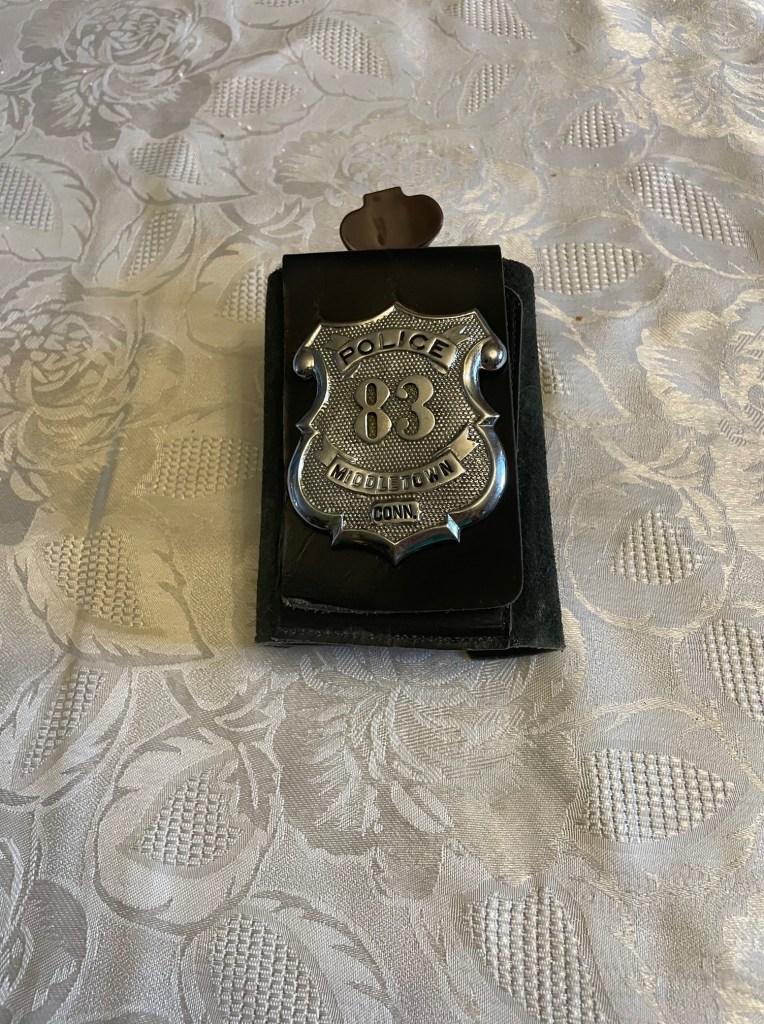
Back at the hospital, uncle Charlie was a shadow of his former six foot 300 pound self. In healthier days, he sported a Santa Claus physique. His personality, as best I could tell, was not that of jolly old St. Nick. I’m not implying he was nasty, cranky or cantankerous. As a matter of fact, I heard he was not a mean drunk. Thank goodness since he was never without a revolver and a blackjack. I also never heard stories about beating his wife (my beloved Aunt Margaret) who was his drinking partner and a nice person.
I had very few interactions with uncle Charlie. I wish I asked him what it was like to be a cop in the 1960’s in the midst of race riots. As a history buff who’s a junkie for all topics about societal issues, I hunger for such conversations. Since I’m now a retired mall cop, we could have spent hours trading stories, escapades and commiserating about society’s challenges. But that was not to be. Alcoholism took him too soon, I was sheltered from that scourge and I was born too late. Years later my aunt Agnes told me about the time a car ripped the stripe off the side of his pants while he was directing traffic. And then there was the time he reportedly fake arrested her as a shoplifter on Main Street much to her embarrassment. It was all for a good cause. He had to have an excuse to put her in the patrol car to give her a ride home since she was loaded down with groceries. Reportedly there was an incident when he and another cop were checking out a building responding to a burglary call. For some reason, he and his partner were in separate sections of the building and the partner’s gun accidentally discharged. This was back in the day when cops actually walked beats and before SWAT teams. This was in a time when you didn’t have to account for your ammo or fill out paperwork concerning such incidents. First hand accounts from Charlie would have been nice but at least my aunt passed down what now is family folklore. My gnawing regret is that I only knew him in two dimensions as a cop and an alcoholic. And he was good at being both. My first cousin, who was 12 years older than me, mentioned he appreciated that Charlie was like a father to him because his own dad was what I guess you would call a “working alcoholic”. Again, troubles swirled around but I was young and buffered from these storms. This enabling me to be the first on this side of the family to go on to college and even on to graduate school.
I don’t recall discussions about Charlie at the dinner table even though his downward spiral had to have weighed heavy on all family members. We lived in the same town, he was a local cop and WW2 vet. I wish I had been privy to his current struggles, hopes and dreams. He served in the army in the campaign to rid Italy of Mussolini. I heard that he was blown out of a foxhole and for a time his young bride thought he might have died. Fortunately he was patched up with no long term physical ailments. Though now that I’m retired from a career related to mental health and addictions, I wonder what psychological scars remained and what role they might have played with the alcoholism. With no conversations and the misalignment of time with me being a kid and him being an adult, I will never know.
Being kept in the dark and sheltered from family troubles and financial troubles was a characteristic of growing up in the 1960’s and 1970’s, It’s also a characteristic of Irish-Catholic and Irish American households. The best demonstration of compartmentalism and sweeping your troubles under the carpet is how the Irish make references to the “Troubles” when describing what’s really civil wars and rebellions.
Looking back to that hospital visit, I wondered about its circumstances and purpose.
Did my dad want to make sure I got a first hand glimpse of alcoholism’s descent into hell. Did he want this to be a scared-straight type experience?
Was my dad notified that this would be a last-chance visit to see his older brother? My mom worked the day shift and dad worked the midnight shift, so maybe I was tagging along just so I would not be left alone.
Answers to these questions I will never know. Leading up to this hospital visit, during it and after it, I don’t recall any debriefing or in depth conversation. This pattern of doing but never discussing is a recurring theme for most events of my life.
Even when it was time to attend uncle Charlie’s wake and funeral, which presumably happened soon after that hospital visit, I’m hazy about what transpired. I’m even a bit embarrassed about being unclear as to whether I attended. I’m assuming I did since it happened way before I went off to college. It was at his wake that I recall my uncle Louie (my fathers and my uncle Charlie’s oldest brother) making the following remarks under his breath after mourners offered the traditional consolation “sorry for your troubles” (there’s that word “troubles” again):
After one mourner passed beyond ear shot, Uncle Louie remarked:
“I’d like to punch that sneaky bastard in the mouth. Screwed me in a deal”.
After another mourner passed, he informed me “that’s the king”, to which I asked “the king of what? He said “the chairman of the local political party and he’s a high ranking state official”. Maybe that’s when I decided to major in political science in college.
I’m wondering if I suffer from a special kind of amnesia in which I remember snippets of what should have been a panoramic recollection of memorable and emotional events. I’ve attended my share of weddings, funerals, and graduations. But the memories are choppy. It’s like knowing you attended a movie but you only recall certain lines and scenes. It concerns me that I only recall the anecdotal, quirky and weird stuff. Even worse, I have difficulty remembering if I even attended these supposedly momentous events. Was I AWOL? If so, what else was I doing? Was I in attendance but somehow disconnected like a sleepwalker or zombie?
I’ve wrestled with this sense of selective amnesia and missing conversations. I’ve come to the following solution. I’ve made a concerted effort to have in-depth and candid discussions with my kids on matters such as family, finances, troubles and the watershed moments of life. I’m hell bent on making sure they remain aware of the big picture and as the saying goes “not miss the forest for the trees”.
 Dunn Writes Well